
Spinning and Auxiliary Forming to Produce a Ventilation Duct Section with Reinforced Flange
From welded assembly before to single-piece controlled forming now
The Challenge
A manufacturer of industrial ventilation systems was producing cylindrical duct sections by:
- Rolling sheet metal
- Welding longitudinal seams
- Welding separate flange rings
- Drilling connection holes in secondary operations
The approach created:
- Long production cycles
- Welding distortions affecting roundness
- Inconsistent flange geometry
- High labor costs
- Increased part weight
The requirement was clear: Reduce welding. Stabilize geometry. Improve production efficiency. Achieve final shape while maintaining full control over material flow, temperature and forming forces.
The DENN Solution
DENN re-engineered the part using controlled spinning and auxiliary forming operations on NTR and RB machines.
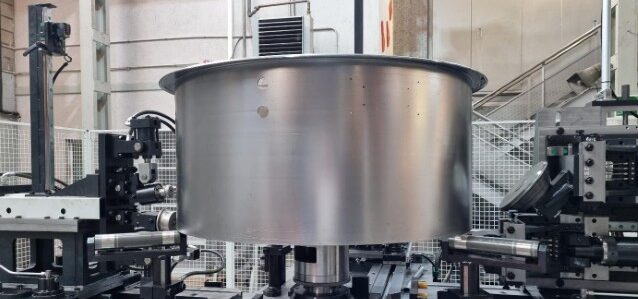
Instead of assembling multiple components, the duct section is formed from a flat stainless-steel disc (blank) into a single-piece cylindrical body.
The process integrates:
- Spinning to form the cylindrical geometry
- Controlled wall thickness reduction
- 90° flanging with reinforced edge
- Integrated rib formation for structural stiffness
- Final drilling operation for assembly
All operations performed in a stable, repeatable cycle. No welded flange ring. No distortion from heat input. No geometry correction required.
The Result
The transformation delivered measurable impact:
- Single-piece component instead of welded assembly
- Improved roundness and dimensional stability
- Reinforced flange with reduced overall weight
- Faster production cycles
- Significant cost reduction compared to traditional fabrication
In addition, reinforced flanges increased structural rigidity while allowing thinner starting material, improving airflow efficiency and reducing material consumption.
Why It Matters:
In ventilation systems, geometry directly affects airflow performance and installation precision.
By eliminating welding and controlling material flow through rotational forming, the manufacturer achieved:
Stable output. Lighter parts. Higher productivity.
At DENN, we simplify complexity, replacing multi-step fabrication with controlled metal forming.